
6. Service Blueprints & Defining Problems
Service Blueprints
Researching the Problem
Problem Statement & Background/History for Proposed Design
Background & Purpose
In order to create a successful engineering design, your team first needs to define the problem itself.
We will use aspects of service design to help us formulate this background and problem statement in order to move forward with the Team Project. Service design focuses on understanding interactions between people [1, p. 22], and it “is about designing with people and not just for them” [p. 41].
You’ll use this background and history of the problem again to develop the design proposal.
Research the Project’s Context
First, your team needs to research the context for your design project. Scholarly literature and research can demonstrate a problem, a solution, the background, and/or the history of your design opportunity.
Each team member is required to contribute no fewer than three reference entries to this report. In-text citations must appear in the body of the report, accompanied by a References list at the end. Concentrate on scholarly, published research that is available in the library databases. You may also use reports provided by your team’s project partner (if applicable) or other related documents.
Literature should be cited throughout this report: the problem and the background/history. Here are some examples of how to integrate research-based evidence into each section:
- Problem: Researching a problem in order to create communication deliverables to help solve it requires carefully defining the problem and its context. Your team must cite research on how others have solved or attempted to solve this problem and/or research related to the problem or its context.
Include primary research that your team has conducted. This often involves surveying or interviewing users in order to get ideas to design the most effective engineering design.
Draw upon primary and secondary research in order to concretely define the problem.
- Background/History: How did this situation arise? Who are the relevant people or organizations involved? Did the pandemic create new challenges or opportunities for a topic to exist? The history might also include how other people have attempted to solve—or perhaps ignored—this problem in the past.
Synthesize the Literature
Research is like chocolate chips, and your writing or content is like cookie dough. The chocolate chips need to be thoroughly mixed into the dough, not plunked in erratically or sprinkled on top at the end. Paragraphs should integrate research, meaning that they generally do not act as a topic or concluding sentence.
Pro tip: The Resources section below contains the engineering librarian’s contact and a slide deck on annotated bibliographies.
Visualize the Background and History of the Problem
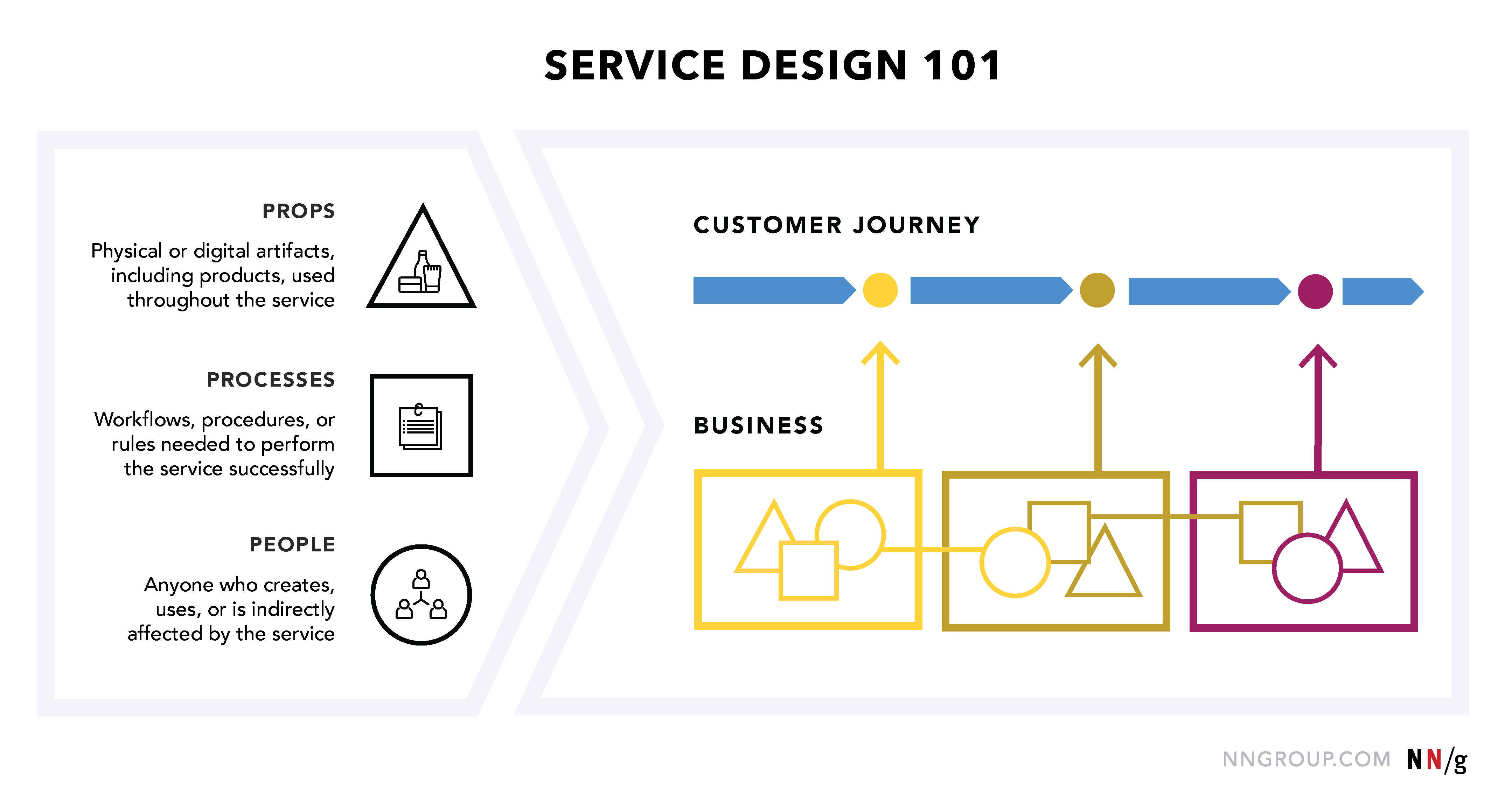
Knowing about the people (users) who will use your engineering design, as well as the agents and enterprises that intersect with this design, is imperative. In service design, this is known as a service ecology.
Mapping the service ecology helps to understand and visualize the various actors involved, the value exchanged between these actors, how the actors communicate in order for an engineering design to have value, and the iterative process of change while developing an engineering design.
Task 1: Map the Project’s Service Ecology
As a team, determine the props, processes, and people involved in this project:
- Props include physical or digital artifacts (interfaces).
- Processes include workflows, procedures, or rules.
- People include creators, users, or benefactors of the service.
Create a visualization (table or figure) for the service ecology. Integrate the team’s visualization into this report.
Task 2: Visualize the Service Blueprint
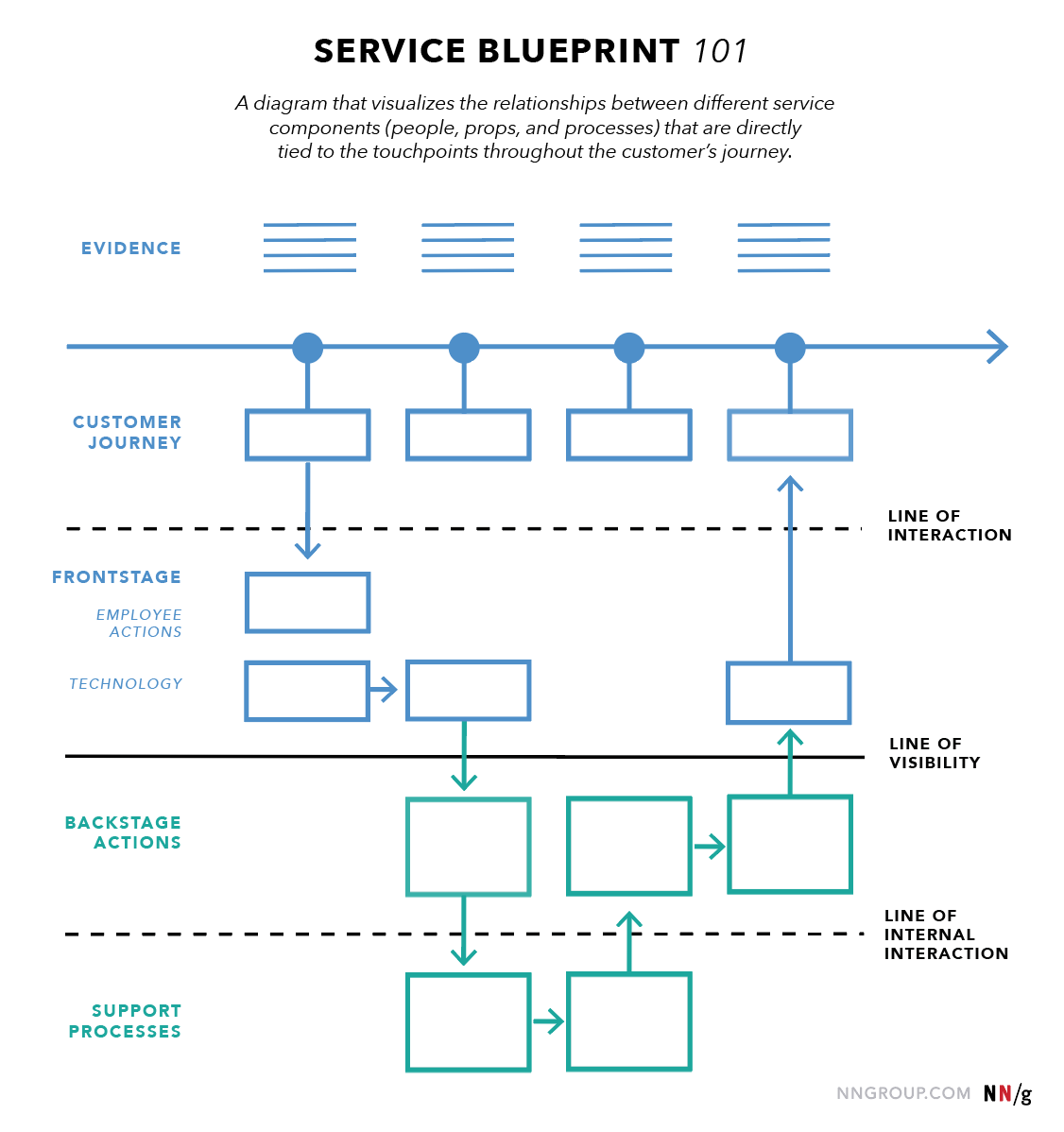
To design communication deliverables, your team must create a service blueprint, “a diagram that visualizes the relationships between different service components — people, props (physical or digital evidence), and processes — that are directly tied to touchpoints in a specific customer journey” [3]. You might think of this as putting the service ecology into motion by considering the touchpoints between users and the service. What the user interacts with is considered frontstage, whereas what goes on behind the scenes in order for that service to be provided is known as backstage.
Formatting the Report
Apply what you have learned from writing previous memos and reports about formatting.
| Component | Requirement |
|---|---|
| Length | No more than 750 words (not including words in tables and/or figures) |
| Header | to your instructor, from your team [include individual names and team name], subject, and date |
| Headings |
|
| Spacing | Single spacing |
| Page Numbers | Bottom right of document |
| Citations | In-text citations and a References page in APA, IEEE, or MLA formatting (see the Citation Styles page for guidance and links) |
| References | At least 3 references/sources per teammate from a scholarly, published source or a trusted university-related entity (such as a Cornell-generated report) |
Resources
- Searching library databases: Schedule a library consultation with an engineering librarian. They can walk you through how to identify keywords or search terms, databases to search, and perhaps even recommend specific journals. Set up a team consultation meeting by emailing: engrref@cornell.edu to set up a consultation time. Indicate the following in the message:
- You are scheduling a consultation for [Name of Class]
- If you would like to meet in-person or via Zoom
- Availability, three or four days/times to meet
- Research questions/needs (what do you want to address during the consultation?)
- Write an annotated bibliography (slide deck)
- Citation Styles
- Citation Videos
Submitting the Proposal
Elect one teammate to submit the commenting link to the Google Doc. Watch the brief video below to see how to obtain the commenting link.
Grading Method
One person will submit the document for the whole team. However, that doesn’t mean that everyone will get the same grade. As stated above, your instructor will consider the division of labor and quality of work as evidenced in the Google Doc version history.
Note: Though it is infrequent, students have been downgraded for not contributing equally to the team and its deliverables.
References
- [1] A. Polaine, L. Løvlie, and B. Reason, Service Design: From Insight to Implementation. Brooklyn, NY: Rosenfeld Media, 2013.
- [2] S. Gibbons, “User Need Statements: The ‘Define’ Stage in Design Thinking,” Nielsen Norman Group, 2019. [Online]. Available: https://www.nngroup.com/articles/user-need-statements/. [Accessed Jul. 09, 2020].
- [3] S. Gibbons, “Service Blueprints: Definition,” Nielsen Norman Group, 2017. [Online]. Available: https://www.nngroup.com/articles/service-blueprints-definition/. [Accessed Mar. 22, 2021].
Insights Summary
Recall from Chapter 4 of Service Design the two ways that you can summarize insights from interviews: insights blogs and insights boards. We recommend creating insights boards because they can be combined well with your team’s user persona.
Levels of Insights and Insights-Gathering Methods
In Chapter 4 of Service Design, you learned that there are three levels of insights: low, middle, and high. Hopefully, your team has at least conducted a low-level insight gathering method so far. You may have even done a site visit, which would be considered a middle-level insight. As a team, summarizing the insights you’ve gathered so far can start to move your design project toward a high-level of insight.
Now that your team has some insights, there are still remaining questions to answer that will guide your design, prototype, and iteration(s). Determine what questions to ask a new or existing user in a depth interview, which is defined as “long, in-context interviews that tend to be fairly open in their structure” (Polaine, Løvlie, & Reason, 2013). The authors of Service Design recommend, “Meet participants in their own homes or places of work to bring ethnographic context into the interview” (Polaine, Løvlie, & Reason, 2013).
Resource: Service Design (course textbook)
Refer to the reading from Service Design, particularly Chapter 4, “Turning Research into Insight and Action.”
Submitting Instructions
Elect one teammate to submit the commenting link to the Google Doc. The brief video below shows how to obtain the commenting link.
Grading Method
One person will submit the document for the whole team. However, that doesn’t mean that everyone will get the same grade. As stated above, we will also consider the division of labor and quality of work as evidenced in the Google Doc.
Note: Though it is infrequent, we have downgraded students in the past for not contributing equally to the team and its deliverables. Your team should also establish its own expectations and conflict resolutions in the Team Workflow Agreement.
Reference
Andy Polaine, Lavrans Løvlie, & Ben Reason. (2013). Service Design: From Insight to Implementation. Rosenfeld Media. https://catalog.library.cornell.edu/catalog/16410339